Core Concepts
How does the Lib work?
TgramDND uses Flows and LogicBlocks to run.
Every bot has a main App Instance, which is responsible
for containing all Flows and LogicBlocks.
An app contains Flows, which contain LogicBlocks, which have a series of actions.
What Is A Flow ?
a flow is a collection of LogicBlocks and is responsible for passing needed updates through them
Flows has a lot of kinds, there is MessageFlows which is responsible for Message handling and CallbackFlows that are responsible for Callbacks handling, etc…
they behave all the same, but just handle different types of Updates
What Are Blocks (AKA LogicBlocks) ?
Blocks are like a function in a simple manner each block has a filter, and an action_list or actions
a Block is responsible for passing the updates to all of its actions 1 by 1
Blocks has a lot of kinds, there is MessageBlocks which is responsible for Message handling and CallbackBlock that are responsible for Callbacks handling, etc…
they behave all the same, but just handle different types of Updates
What Is An Action?
Action is the smallest unit of a Flow, an action is used to execute something or preform a specifc task
Actions are like a function logic/lines in a simpler manner
How It All Works?
The below photo is a visual explantion to how the Flows work
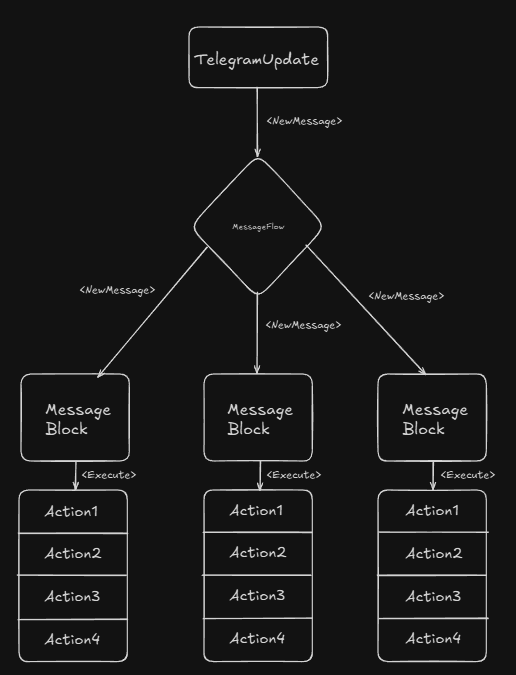
Basically, A new update gets to your Telegram bot This NewMessage gets passed to all your Flows then each Flow passes this update to there LogicBlocks Then if the block filters matches the incoming update it will execute its Actions 1 by 1
Note
when running an App it will inject itself across all
of its flows, blocks and actions, so every action can access the App resources
Note
Filtering
All of your Flows and LogicBlocks can have Filters attached to them that way they only act if a specific update matches all of there filters you can read more about filters Here
For Example
Lets say we have a MessageFlow, that filters messages with the text “!hello” or “!hi” and 2 MessageBlocks one filters messages with the text “!hello” and other filters “!hi” respectively and each block has only 1 action, that replies with the opposite keyword so the “!hello” Block, responds with “!hi” and viceversa
Lets see the code example
first lets make a starter setup
from tgram_dnd import (
    App,
    MessageFlow,
    MessageBlock,
    Reply
)
from tgram import TgBot, filters

bot = TgBot("INSERT_BOT_TOKEN")
app = App(bot=bot)
Great ! now lets make our message blocks
hello = MessageBlock(
    # this block will reply with "hi!" when getting a message with the text "!hello"
    Reply(
        # reply_method
        "text",
        kwgs={"text": "hi!"}
    ),
    filter=(filters.command("hello", prefixes="!"))
)
hi = MessageBlock(
    # this block will reply with "hello!" when getting a message with the text "!hi"
    Reply(
        "text",
        kwgs={"text": "hello!"}
    ),
    filter=(filters.command("hi", prefixes="!"))
)
Awesome!, now finally lets make the Flow Which Will filter only !hi and !hello messages And add it to our app
flow = MessageFlow(
    blocks=[hi, hello],
    filter=(
        filters.command(["hi", "hello"], prefixes="!")
    )
)

app.add_flows(flow)
Finally lets run our App
app.run()
now try it in action 😎
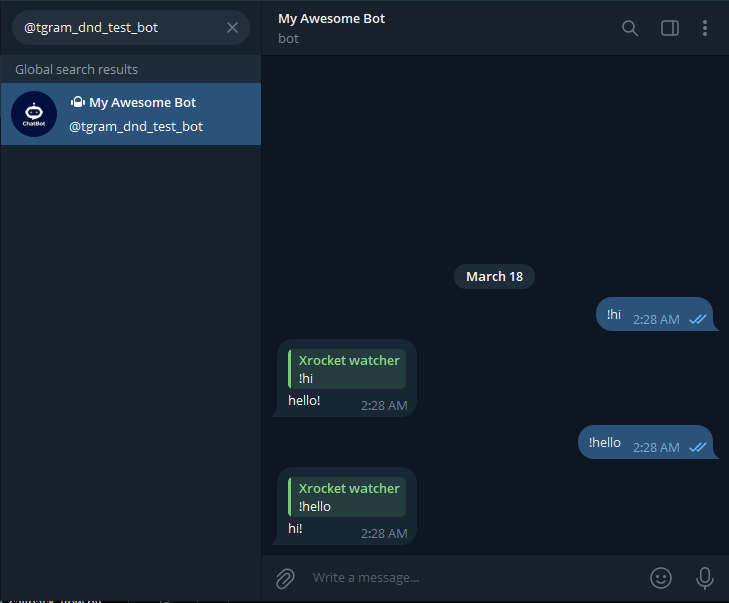
Access this example from Here By now you should know how the lib works!